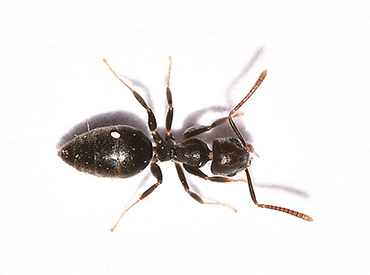
White-Footed Ant are commonly found foraging along branches and trunks of trees and shrubs that have nectars and sap-sucking insects that produce honeydew. Frequently, white- footed ant find their way inside the wall voids where they follow electrical cables and emerge into various rooms, especially kitchens and bathrooms, where liquid and solid foods can be encountered, resulting in heavy trailing activity. Although white-footed ants are strongly attracted to sweet foods they will also feed on dead insects and other protein. A colony of white-footed ants has several fertile females, some of which are workers. They are capable of starting a new colony, by leaving with a number of juveniles for another site.
| Common name | White-Footed Ant |
|---|---|
| Scientific name | Technomyrmex Difficilis (Albipes) |
| Size | Worker ants -2.5 to 3 mm Sexually matured -3.5 to 4 mm |
| Colour | Black to brownish-black ant with yellowish-white feet |
| Shape | Segmented; oval |
| Habitat | Branches and trunks of trees |
| Life span | Worker ants -40 to 60 days Queen ant -one year |
LIFE CYCLE:Eggs: Eggs are laid, usually by a queen, in the nest they are protected by workers. They may be fertilized or unfertilized. Eggs are tiny in size .5 mm, white or yellowish ovals and have been found, along with other developmental stages, in nests constructed of dirt and plant rubbish in red ginger flowers.
Larva:Young larvae are soft, legless, pale grub shaped. They have a fat and bulbous bottom and a narrow and curled shape at the head. Adult ants lick the larvae, and the saliva makes them sticky and are easily transported in groups when the colony is disturbed. Most ant species have four larval stages. The larvae are attended by adults, usually of the worker caste.
Pupa:White-footed ants develop from larvae into pupae without spinning cocoons.
Adults:Adults are polymorphic, i.e., having different body types. Adults of one body type form a social unit called a caste, which is also defined by the role in the community. Queens are usually comparatively large and winged early in life. They are reproductive, laying fertile and unfertile eggs throughout their lives. Males are usually short lived and function only in reproduction. Males lack wings and are very similar in appearance to workers, a condition in ants referred to as ergatomorphi. Adult workers are wingless, medium-sized, dull black ants 3.5 to 4 mm long. Adults recently emerged from the pupal stage are paler. Workers are females which tend all stages of juvenile ants, construct and maintain nests, and forage for food. Commonly, only individuals of the worker caste are encountered because they are the most numerous and the most likely to be found outside the nest. The White Footed Ant is a medium small, black to brownish- black ant with yellowish -white tarsi and a one-segmented waist. A member of the subfamily Dolichoderinae, White Footed Ant has five abdominal segments, 12-segmented antennae, few erect hairs, and no sting Their total life span can be as short as one year, but may more in ideal conditions. Queen ant lives for one year
DAMAGE Since they tend honeydew‐producing insects (mealy bugs, aphids, soft scales, whiteflies) protecting them from control by natural enemies , the damage caused by the White Footed Ants are usually indirect. Although these are strongly attracted to sweeter foods, such as plant nectar and honeydew, they also feed on decaying plant and animal tissue. White Footed Ants are a nuisance to homeowners as they forage indoors and outdoors, attracted by food.