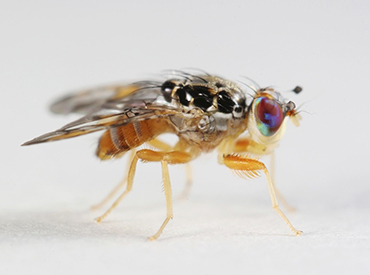
The Phoridae are a family of small, hump-backed flies resembling fruit flies. Phorid flies can often be identified by their escape habit of running rapidly across a surface rather than taking to the wing. This behavior is a source of one of their alternate names, scuttle fly. Another vernacular name, coffin fly, refers to Conicera tibialis. Approximately 4,000 species are known in 230 genera. The most well-known species is cosmopolitan megaseliascalaris. At 0.4 mm in length, the world's smallest fly is the phorid euryplateananaknihali. It is one of the more common species found within the family Phoridae; more than 370 species have been identified within North America.
| Common name | Phorid |
|---|---|
| Scientific name | Phoridae |
| Size | 1/8 inch length |
| Colour | DarkBrown |
| Habitat | Escape habit of running rapidly across a surface rather than taking to the wing. |
| Life span | About14 to 37 days |
Egg:Phorid flies typically breed in moist, decaying organic matter. Female Phorid flies lay an average of 40 eggs in a 12 hour and approximately 500 eggs over the course of their lifetime. The eggs hatch in 24 hours into tiny whitish to yellow maggots; where they feed and develop in the medium for 1 to 2 weeks depending on environmental factors, such as temperature. Upon reaching maturity, the larvae leave the breeding medium in search of a dry area to pupate. It typically takes between two weeks and a little over a full month to complete life cycle from egg to adult depending on temperature. However, adult Phorid flies only live for a few days.
Larva:Phorid flies reproduce rapidly.. The eggs hatch into larvae, also known as maggots. Phorid fly larvae are legless and spindle-shaped, measuring 4 to 10 milli metres in length. Their colour depends on the species but typically varies from whitish to light-yellow.
Adults:The adult females of many Phorid fly species in Canada lay their eggs in or on decaying organic materials, such as animal faeces or carcasses, sewage, rotting food and plants, and the layers of film that build up on the sides of drains. When larvae hatch from the eggs, the immature insects feed on the organic matter comprising the surrounding environment. The larvae of some Canadian Phorid flies even parasitize other animals. Depending on the particular species, parasitic types of Phorid flies lay eggs in the nests of ants, bees, termites, and wasps as well as on the bodies of live beetles, caterpillars, and millipedes. After emerging from the eggs, the newly hatched larvae feed on the occupants of the nest or the living animal in which they were deposited. All Phorid flies spend about 8 to 16 days in the larval phase of development, depending on the environmental conditions.