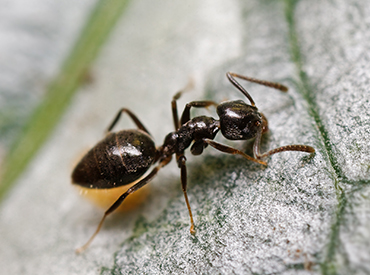
Odorous House Ant gets its name from the strong, rotten coconut like smells it gives off when crushed and the fact that they commonly nest in or around houses. These ants are very smelly, they are also quite small. However, the true telltale characteristic of the odorous house ant is unquestionably the foul odor they give off when their bodies are crushed. They live Outside of the houses too, odorous house ant nests have been reported under rocks, inside acorns, mulch, and leaf litter, in potted plant soil, in garbage cans, lawn furniture and cars. Indoors, they get a little more creative. Nests have been found under doormats, in dishwashers, and even under a toilet seat. Typically, odorous house ants prefer to nest near heat or water sources and in insulation. They feed on anything, including insects, seeds and plant secretions, but prefer sweets. They are extremely fond of honeydew, a sugary waste produced from sap-sucking insects such as aphids. Inside homes, odorous house ants will feed on sweets, meats, grease, dairy products, pastries, cooked or raw vegetables, and fruit juices. The ant colonies can range from fewer than 100 workers and one queen to more than 10,000 workers and hundreds of queens. They are virtuosos in the nesting department.
| Common name | Odorous House Ant |
|---|---|
| Scientific name | Tapinoma Sessile |
| Size | Worker ants- 2.4 to 3.25mm Sexually matured- 3.75 to 4.3 mm |
| Colour | Brown or black |
| Shape | Segmented; oval |
| Habitat | Typically living for several years, these ants commonly make their homes in exposed soil, under stones, logs, mulch, debris and other items. They will also nest in wall and floor cracks. |
| Life span | Worker ants- 12 to 17 months Queen ant -3 months to year |
LIFE CYCLE:Eggs: Eggs are sub elliptical in form and pearly white in color, measuring 0.24 by 0.39 mm. Eggs hatch between 11 to 26 days.
Larva:Larvae are the size of an egg when they first hatch, and grow to about 0.72 by 1.74 mm. As they grow, their head starts to curve. Their body is segmented and yellowish, and becomes very plump and thick when its fully grown. They also have a distinct bump on their bodies near their tail.Pre-pupae look like full grown larvae, measuring about 1.8 mm in length. The larval stage takes 13 to 29 days and the prepupal stage takes about 2 to 3 days.
Pupa:As they start to reach the pupal stage, their skin becomes dry and wrinkled. Pupae do not have cocoons; they are naked and white, with no markings and are typically 1.82 to 2.29 mm in length. After a couple days, their eyes begin to turn brown and then black, as their mandibles also turn brown and their body begins to turn shades of yellow. The pupal stage lasts anywhere from 8 to 28 days, averaging about 14 days in the summer.
Adults:After coming out of pupation, it takes a few days for adult ants to attain full color have dark brown or black bodies with an unevenly shaped thorax. Queens are larger at 3.75 to 4.3 mm in length & measuring approximately 2.4-3.25mm long. They have a square head, large eyes, and stout antennae. They have a single node on their petiole, hidden by their abdomens. In natural conditions, workers are likely to live for 12-17 months, while the queen is likely to live for 3-12 months to a year or more. Males die about in 1 week to 10 days after mating.
DAMAGES Odorous House Ants are nest in mulch, debris piles, or inside buildings. Because these ants maintain such large colonies in urban areas, it is difficult to get rid of them. Pesticides and baits may kill a few nests, but other nearby nests can easily recolonize the area. The widespread use of pesticides may also remove competing ant species from their area, which may benefit the odorous house ants. With the competition removed, colonies of odorous house ants are free to move into the area. The landscaping trend of placing mulch outside buildings attracts the ants to urban areas. Their population can be controlled by removing or replacing the mulch. Odorous house ants also tend to protect many aphid species which are also crop pests. By maintaining and protecting these aphid populations from predators and parasites, these ants indirectly cause crop and other plant damage.