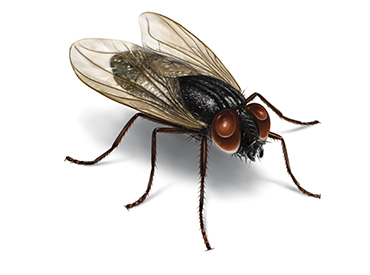
House Flies are mostly likely encountered in hot summer and early fall weather. They are active during daylight hours. It can be seen from the month of May and September. An egg mass has found an early as May 5th and as late October 13th. It lies in wait in shady areas under bushes and trees for a host like they found in salt marshes, swamps, bogs, shallow lakes and along the water edge. Males and widely spread out in the females. The male emerges before the females. After emergence of both sexes, the flies mate. Mating starts with the male pursuing the female. Mating is initiated in the air and completed on the ground. The House flies are most prone to attack during daylight hours with a peak beginning at sunrise and lasting three hours. The frequency is low on overcast days or at temperatures below 22 and above 32 degrees celsius. Its biting occurs on the abdomen, legs and neck. The bites can be very painful. They have mouth parts that work like miniature knives, which they used to slash open the skin with a scissor-like motion. It bites cattle, horses and humans. The female house fly is the one that sucks blood from mammals, as male house flies do not have a large protrusion on the mouth with the same razor-sharp teeth that females use to tear into the skin of victims. A female house fly must have at least one blood meal before she is able to reproduce eggs. The male House Flies are mainly pollen and nectar feeders and are most active during daylight hours. It transmits Anthrax, reduced weight gain in some animals, lowered gains and low milk production in livestock animals.
| Common name | House Fly |
|---|---|
| Scientific name | Musca domestica |
| Size | 6 to 7 mm. with a wing span of 13 to 15 mm. |
| Colour | Reddish eyes, grey abdomen |
| Habitat | Widely distributed all over the world. Closely associated with humans |
| Life span | 30 to 60 days |
Egg:The egg mass laid by the female can contain anywhere from a few eggs to several hundred eggs. They are laid in layers on a vertical surface, such as overhanging water, projecting rocks, sticks and aquatic vegetation. The vertical surfaces on which the eggs are deposited are always directly over water and wet ground favorable to development of large ones. They are initially a creamy white color but soon it become dark color a spindle shape measuring from 1 to 2.5mm in length. Eggs hatch in 5 to 12 days depending upon ambient weather conditions.
Larva:The larvae use a hatching spine to break out of the egg case. The larva stage takes place in the mud or similar wetland. This stage can last from a few months to a year to complete 6 to 13 stages. The larvae drop from the eggs into the mud or water and burrow down into the soil. It feeds on organic debris, small organisms such as insects, crustaceans, snails and earth worms. The larvae taper at each end and are usually whitish in color , but also can be brownish or green depending on the species. In late spring, the larva migrates towards drier soils and progress into the next life stage, which is the pupae stage.
Pupae:The Pupae stage for a growing usually takes place on dry soil. The pupae stage is also called the cocoon stage. The pupae are brown colored, rounded interiorly and having leg and wing cases attached to the body. The length of the pupa stage depends on the species and temperature, but the stage can last between 6 to 12 days.
Adults:The adult housefly will emerge from the pupae, once the pupae stage is complete. This stage usually occurs during the late summer. They are strong fliers and set out immediately to seek food as well as a mate. It is from 10 to 25 mm. These flies are black to dark brown in color with green or black eyes. The House Flies have broad bodies and bulging eyes.
Adult life span is 30 to 60 days.