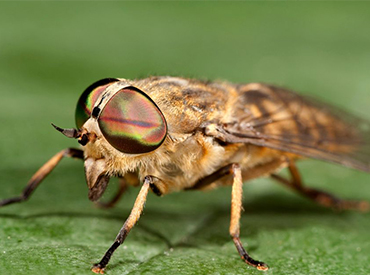
Horse flies are often large and their powerful wings make them swift in flight. They prefer to fly in sunlight, avoiding dark and shady areas, and are inactive at night. Female of these species bites animals and humans . They are commonly found in horse, pigs and cow stables. Horse flies resemble honey- bees. But for their single pair of wings, they look pretty identical from a distance. Horse-fly is the most widely used English common name for biting and blood sucking members of the family tabanidae. These are true flies in the insect order Diptera, which use only the front wings for flight. Horse-flies are often large, but are agile in flight. They are found all over the world except for some islands and the Polar Regions.
| Common name | Horse Fly |
|---|---|
| Scientific name | Tabanide |
| Size | 5 to 55 mm in length |
| Colour | Grey or blackish body. Large green or purple eyes. |
| Habitat | Found world wide except polar regions. They occur in tropical, Moist and warm regions are most suitable for breeding subtropical and temperate regions. |
| Life span | 20 to 40 days |
Egg:The egg mass laid by the female can contain anywhere from a few eggs to several hundred. The mass is usually deposited on the vegetation that hangs over the water. The eggs appear dark and shiny, and are shaped like spindles. They hatch within five to twelve days, and the larvae drop into the water or moist soil.
Larva:Once the larvae have dropped into the water after hatching, they burrow in the river substrate or the ground along the river bank, spending the winter in these burrows. Sometimes the larvae take one to three years to complete the 6 to 13 stages of development (known as 'instars') that are typical in the tabanidae life cycle. In late spring, the larvae migrate towards dryer soils and progress into the next life stage, which is the pupal stage.
Pupae:The length of the pupal stage depends on the species and temperature, but may range from six to twelve days.
Adults:When tabanidae adults emerge from their pupal stage they immediately begin mating and blood feeding. Adults are great fliers, and search for their mates visually. Most species of horse and deer flies have only one generation per year.
Horse flies life span varies from 20 to 40 days.