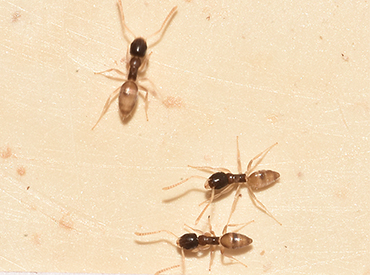
Ghost Ant are found both inside and outside. They may be found in kitchens and bathrooms as they are seeking moisture. Outside, they make their nests in the ground near stones, logs or wood piles, and even moist grass and plant stems. When ghost ants make nests indoors, it is usually inside wall voids or behind cabinets and base boards. They also build nests in flowerpots or other moist areas. They eat honeydew that they collect from aphids and other plant-feeding insects. The worker ants also gather insects to feed the colony. When they are indoors, ghost ants usually prefer sweets.
| Common name | Ghost Ant |
|---|---|
| Scientific name | Tapinoma Melanocephalum |
| Size | Worker ants 1.3 to 1.5 mm Sexually matured 2- 2.5 mm |
| Colour | Dark brown and milky white |
| Shape | Segmented; oval |
| Habitat | Stones, logs or wood piles, and even moist grass and plant stems. |
| Life span | Worker ants-45 to 60 days Queen ant-2 to 6 years |
LIFE CYCLE:Eggs: The queen lays a large number of eggs, which hatch after 2 to 4 weeks to form tiny larvae. Fertilized eggs become female, unfertilized become males.
Larva:Larva hatches out of the egg as a white grub which is narrower towards the head. They are fed by the adults. The larvae stage completes within 6 days.
Pupa:Pupates appears creamy-white, looking similar to an adult. Sometimes, they have a protective silk cocoon around them. Pupae stage takes up to 8-10 days to complete.
Adults:The adult emerges with the three defined body sections: head, thorax and the abdomen. The queens are similar in appearance to a worker, but the mesosoma is enlarged. The queen measures 2.5 mm in length, making them the largest member of the colony. The male’s head and dorsum are dark in colour, while the gagster is light in that may contain several dark marks. They are usually 2.0 mm in length. The length of time between the egg stage and ants emerging as adults can take 6 weeks or more; it depends on a variety of factors such as the species of ant, the temperature and the availability of food. The Ghost Ant is extremely small, 1.3 to 1.5 mm long and monomorphic (one-sized). They have 12-segmented antennae with the segments gradually thickening towards the tip. The head and thorax are deep dark brown with opaque or milky white gagster and legs. The thorax is spineless, and the gagster (swollen part of abdomen) has a slit-like anal opening which is hairless. The life expectancy of a worker ant is just 45 to 60 days. The queen can live up to six years, producing as many as 2 million offspring during her life span.
DAMAGES Ghost Ants are considered a major pest to humans. Actively foraging and even nesting indoors, the Ghost ant can be a serious sanitary issue. The Ghost ant is attracted to sweets and greasy materials and therefore is readily seen near food sources or spills. It is not uncommon in an infested house to discover these ants in packages of candy and sugar when they are passing from dirty areas like drains and rubbish bins to food sources in the home, and while chewing through materials, Ghost ants may transfer germs throughout the home, which can lead to diseases. The ghost Ant has even infested quarantine greenhouses where they have proven impossible to control due to the restrictions imposed on the use of toxins in these greenhouses. In higher northern areas, it has become established in heated greenhouses where they have become a problem, especially when it defends honeydew producing plant pests against introduced biological control organisms.