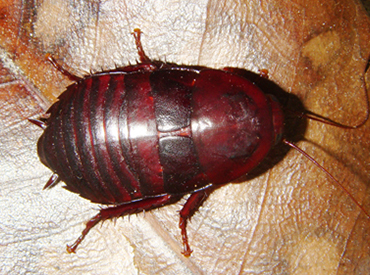
The Florida Woods Cockroach mostly spends its life outdoors and likes feeding on decomposing or decaying plants, fruit and leaves. They live longer than other cockroaches, move slowly, are wingless and have large bodies. Florida Woods Cockroaches possess a unique defence mechanism. When they are under threat, they spray a chemical which is smelly and harmful to sensitive areas, especially eyes and open wounds. Due to its stinky chemical spray, it is also called the Florida Stink Roach, Skunk Cockroach and Palmetto Bug. They are found near abandoned structures, warehouses, greenhouses and water pumps.
| Common name | Florida Woods Cockroach |
|---|---|
| Scientific name | Eurycotis Floridana |
| Size | Approximate 35 to 40 mm |
| Nymphal development | Approximate 110 to 120 days |
| Able to fly | YES |
| Habitat | Hiding in storage areas, greenhouses, shelter boxes and water pumps |
| Life span | 1 year |
Egg:When a female cockroach reaches adult stage, eggs are deposited into an ootheca. At the starting stage the ootheca appear pale as it lacks a hardened cuticle. Over time, the casing will darken from reddish brown to black as the cuticle hardens. The size is about 13 to 16 mm. Nearly 20 to 24 eggs are deposited in the ootheca.
Nymph: Once hatched, the nymphs undergo six to eight molts before reaching adulthood. This time can be accelerated if nymphs are reared in groups of seven molts during pre-adult growth. In the late nymphal stage they commonly have yellow thoracic margins.
Adult:The adult size is from the range of 35 to 40 mm long up to 24 mm wide. The body ranges from reddish brown to nearly black in colour. The wings form short, leathery pads, referred to as tegmina, which barely meet on the midline of the body and do not extend to cover any portion of the abdomen. The average life span is nearly 1 year.