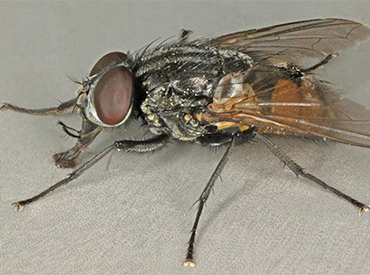
Face fly or autumn housefly survives by sucking body fluids of humans and animals which includes sweat and blood. These face flies are usually found near eyes, nose and back of livestock. These flies are known for causing annoyance to human beings during summer . They sit on the body to suck sweat.
| Common name | Face Fly |
|---|---|
| Scientific name | Musca Autumnalis |
| Size | About 6 to 8 mm long |
| Colour | Grey with 4 dark stripes on the thorax |
| Habitat | Sucking body fluids of man and animalswhich includes sweat and blood |
| Life span | 21 to 25 days |
Egg: Face fly usually lay its eggs on cattle manure. This is yellowish-white egg has two ridges on its dorsal side and is elongated at one end into a slender, grayish-black stalk. Each egg is about 3.0 mm long (including the stalk) and about 0.5 mm wide.
Larva: This yellowish, maggot-like larva develops through three instars and attains a length of 13 mm. The anterior spiracles have 8 to 9 finger-like openings and the posterior spiracles are Dshaped.
Adults: The abdomen of the female is primarily black with an orange base and the eyes are bounded by a silvery stripe. The abdomen of the male is orange-brown with a black base and a black dorsal stripe; the male's eyes almost touch in the center. The thorax of the face fly is dreary with four dark stripes. Mouthparts of the face fly are blunt and do not obtrude straight from the head in bayonet fashion as do those of the horn fly and stable fly.
Puparium:: Slightly smaller than the middle-aged larva, the puparium is gray or dirty white.
Their life span is between 21 and 25 days.