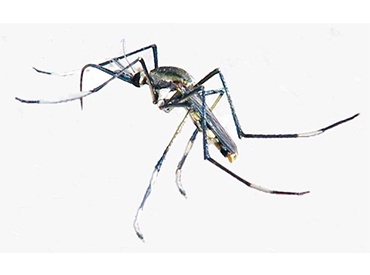
Elephant Mosquitoes are the largest and most colourful mosquitoes found worldwide. Their size depends on the nutritional conditions of the aquatic environment and they can grow to an impressive 18 mm in length with a wingspan of 24 mm.Both male and female Elephant Mosquitoes live almost entirely on a carbohydrate-rich l diet such as saps, juices, nectar and juices flowing from bark of trees. Elephant Mosquitoes prefer living in dense forests and breed in tree holes, shallow swamps or stagnant water in rock holes.Adults are black with a narrow, golden stripe down the centre and gold fringing the outside edge with black strips.
| Common name | Elephant Mosquito |
|---|---|
| Scientific name | Toxorhynchites |
| Size | 18 to 22mm |
| COLOR | Black with a narrow golden stripe down the centre and gold fringing the outside edge of the black stripes |
| Habitat | Hiding at deciduous and forest |
| Life span | Three to four weeks |
Eggs:Adult females lay bright white eggs directly on the water surface in small containers, especially tree holes, pitcher plants, rock pools and the bromeliads. The eggs hatch into larvae within 48 hours.
Larva: The larvae are much larger than other mosquito larvae and quite colourful with a deep reddish colour on the back and greyish on the underside. The larva lives in the water and comes to the surface to breathe. Larvae shed their skins four times, growing much larger after each molt. The larvae feed on micro-organisms and organic matter in the water. During the fourth molt, larva changes into a pupa.
Pupa:The pupal stage is a resting, non-feeding stage of development but pupae are mobile, responding to light changes and moving (tumble) with a flip of their tails towards the bottom or safe areas. This is the time the when the mosquito changes into an adult. When development is complete, the pupal skin splits and the adult mosquito emerges.
Adult:The newly emerged adult rests on the surface of the water for a short time to allow itself to dry and all its body parts to harden. The wings have to spread out and dry properly before it can fly. Blood feeding and mating does not occur for a couple of days after the adults emerge. Adults are black with a narrow golden stripe down the center and gold fringing the outside edge of the black stripes. Palps are long, thick and straight in females and very long and upturned in the males. The average length is 18mm and 24mm in wingspan.Their average lifespan is usually three to four weeks.