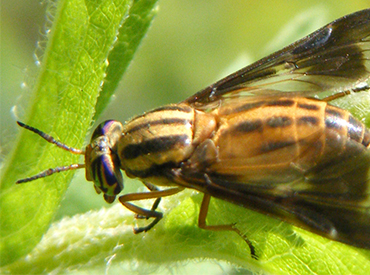
Deer flies are also known as yellow flies due to their yellow-golden appearance and bright compound eyes, and large transparent wings. They are commonly found in cattle sheds and garden areas, which are blood sucking pets, which is most prevalent during the spring season. Deer flies are like mosquitoes suck blood from their preys and thrive on pets such as dogs, cats and do not spare humans.
| Common name | Deer Fly |
|---|---|
| Scientific name | Chrysops Tabanidae |
| Size | Adults range from ¼ to 1/3 inches in length |
| Colour | Yellow-golden colour |
| Habitat | Suck blood from their preys and thrive on pets such as dogs, cats |
| Life span | 30 to 60 days |
Egg:Eggs are laid in layers on a vertical surface such as overhanging foliage, projecting rocks, sticks and aquatic vegetation. Aquatic vegetation is the most preferred. The female will not deposit egg masses on vegetation that is too dense. Eggs are initially a creamy white color but soon darken to gray and black. Eggs are cylindrical in shape and measure from 1 to 2.5 mm in length. Eggs hatch in five to seven days, depending upon ambient weather conditions, and the larvae fall on to the moist soil or into the water below.
Larva:The larvae are aquatic, semi-aquatic or terrestrial. The larvae taper at each end and are usually whitish in redden, but also can be brownish or green depending on the species. Black bands are found around each segment of the body in many species. The larva breathes through a tracheal siphon located at their subsequent end.
Pupae: The pupae are brown tinted, smoothed anteriorly, pointed posteriorly, and have leg and wing gear attached to the body. There is a row of spines encircling each abdominal segment. A pupal "aster" consisting of six critical projections is located at the apex of the abdomen. The pupal phase normally lasts for two to three weeks.
Adults: Adult Tabanidae are large flies with broad bodies and bulging eyes. The males are easily differentiated from female flies because eyes are flanking in the males and widely separated in the females. In the majority species, the males become known before the females. After emergence of both sexes, the flies mate. Mating starts with the male pursuing the female. Mating is initiated in the air and completed on the ground. The female then deposits an egg mass and is set to hunt for a host.
Their average lifespan is from 30 to 60 days