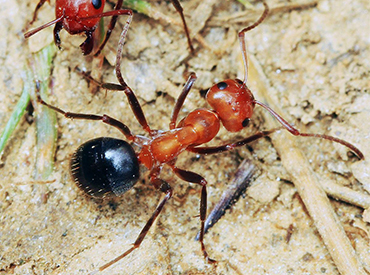
Allegheny Mound Ants are named for their large, conspicuous nests which can be 2 meters or more across and a meter high. .Everywhere, it builds large, sub conical, mainly earth mounds. This ant apparently subsists largely on honey dew and extra floral nectar, but also scavenges or occasionally preys on various arthropods, especially, phytophagous insects. The mound serves as a solarium, collecting heat from direct sunlight to warm the colony.
| Common name | Allegheny Mound Ant |
|---|---|
| Scientific name | Formica Exsectoides Forel |
| Size | Worker ants 4.5-7.5 mm Queen 8-9 mm |
| Colour | Red-orange, black |
| Shape | Segmented; oval |
| Habitat | Woodlands or pinelands, sunny openings in denser tree populations, the edge of prairie groves, and open meadows and mesictall grass |
| Life span | Worker ants-1 to 3 Years Queen ant-30 Years |
LIFE CYCLE:Eggs: Small, white elliptical eggs are found within the mound. Eggs are hatch in 2-4 weeks
Larva:After hatching, the egg becomes a legless larva. Larval development takes approximately 3 to 7 weeks. Larvae are completely dependent upon foraging workers for food and survival.
Pupa:Upon completion of the larval stage, pupae are formed and remain within the pupal stage for approximately 2 weeks
Adults:An Allegheny Mound t, ant’s growth from egg to adult, ranges from 2 to 3 months, depending upon soil temperatures. After the complete development of the ant, the sexually mature ant becomes the queen and are Red-orange, black colour.
The lifespan is of worker ants last for 1 to 3 years and that of the queen ants up to 30 years.