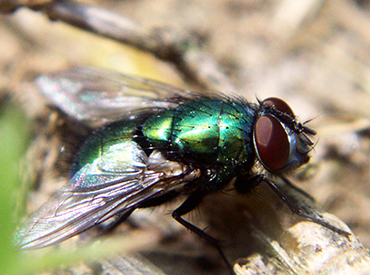
Bottle flies are larger than the house flies with a shiny bottle blue to blue-greenish colour. Shaped like a bottle, these flies are found all across the world. The wings of bottle flies are transparent with visible veins, the body is mostly bluish and its antenna and legs are black in colour. They are considered as dangerous pests since they cause contamination of food by laying eggs and transmit diseases. They prefer warm climate commonly found in humid coastal areas but it also present ia arid areas, their larva feed on decomposing tissues, they favour animal farms, especially of domestic sheep. The common bottle fly (biological name Phaenicia sericata or Lucilia sericata) is a blow fly found in most areas of the world, and the most well-known of the numerous green bottle fly species. The female lays her eggs in meat, fish, animal corpses, infected wounds of humans or animals, and excrement. The larvae feed on the decomposing tissue. The insect favours species of the genus ovis, domestic sheep in particular. This can lead to Blow fly strike, causing problems for the sheep farmers, though Lucilia sericata is not a major cause of blow fly strike in most regions.
| Common name | Bottle Fly/Common Bottle Fly |
|---|---|
| Scientific name | Lucilia Sericata |
| Size | 10–14 mm long |
| Colour | shiny bottle blue to blue-greenish colour |
| Habitat | Female lays her eggs in meat, fish, animal corpses, infected wounds of humans or animals, and excrement and transmit diseases. |
| Life span | 17 to 35 days |
Egg:The life cycle of lucilia sericata is typical of flies in the family calliphoridae in that the egg hatches into a larva that passes through three instars, enters a pre pupal and then a pupal stage before emerging into the adult stage or imago. The female lays a mass of eggs in a wound, a carcass or corpse, or in necrotic or decaying tissue. The eggs hatch out in about 9 hours in warm moist weather, but may take as long as three days in cooler weather. A single female lucilia sericata typically lays 150−200 eggs per batch and may produce 2,000 to 3,000 eggs in its lifetime
Larva:The larva feeds on dead or necrotic tissue for 3 to 10 days, depending on temperature and the quality of the food. During this period the larva passes through 3 larval instars. At a temperature of 16°C the first larval instar lasts about 53 hours, the second about 42 hours and the third about 98 hours. At higher temperatures (27°C) the first larval instar lasts about 31 hours, the second about 12 hours, and the third about 40 hours. Third instar larvae then drop off the host onto soil, where available.
Adults:Adults usually lay eggs about 2 weeks after they emerge. Their total life cycle typically ranges from 2 to 3 weeks, but this varies with seasonal and other circumstances. Lucilia sericata usually completes 3 or 4 generations each year in cold temperate climates, and more in warmer regions. It is 10–14 mm long, slightly larger than a house fly, and has brilliant, metallic, blue-green or golden coloration with black markings. It has short, sparse black bristles (setae) and three crossgrooves on the thorax. The wings are clear with light brown veins, and the legs and antennae are black.
The life span of common bottle flies is 17 to 35 days